


In January 2026, OpenAI officially launched ChatGPT ad testing and simultaneously rolled out the low-cost ChatGPT Go subscription plan priced at $8 per month, accelerating its commercialization drive. For cross-border operators and ad optimizers, accurately verifying ad display effects in the U.S. market and avoiding platform risk control have become core demands. Residential proxy IPs, with their advantages of authenticity and regional adaptability, have gradually emerged as key tools supporting such testing efforts.
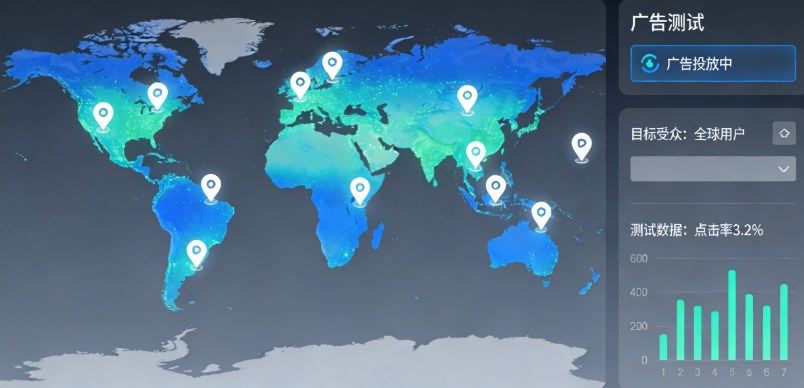
ChatGPT Ad Testing: Launch of Tiered Operations and Interactive Rules
Adopting a “restrained innovation” principle, OpenAI has clarified three core rules for this ad testing—tiered delivery, interactive formats, and compliance boundaries—exploring monetization paths while safeguarding user experience.
1. Tiered Delivery Focused on the U.S. Market, Balancing Experience and Monetization
The ad testing is limited to free users and ChatGPT Go subscribers in the United States, while ChatGPT Plus, Pro, and enterprise users enjoy an ad-free experience. This design aligns with OpenAI’s “four-tier pyramid” operation strategy, tapping into the value of non-paying users through the “low-cost subscription + ads” model. The ChatGPT Go plan offers 10 times the usage quota of the free version and access to the GPT-5.2 Instant feature, replicating the mature profit model of the streaming media industry.
2. Innovative Conversational Ads to Boost Conversion Efficiency
Ads are displayed as “conversation nodes” at the bottom of responses, clearly marked as “Sponsored Content” to separate them from the main text without interrupting the user experience. For example, when a user inquires about a recipe, ChatGPT first provides a complete cooking plan, followed by a sponsored prompt for ingredient purchases, achieving precise matching between user needs and ads. Users can directly ask follow-up questions about the ads and complete decision-making inquiries within the conversation interface, further increasing the likelihood of ad conversions.
3. Defining Compliance Boundaries to Avoid Experience Disruption
OpenAI has set clear red lines for ad delivery: ads will not affect the objectivity of responses or favor sponsored products, no ads will be inserted in conversations involving sensitive topics such as health and politics, and user conversation data will be strictly protected and not disclosed to advertisers. During the testing phase, ads are only displayed when the AI determines a high match with user needs, minimizing interference with the user experience.
Residential Proxy IPs: Practical Applications and Pain Point Solutions
Reporters learned that residential proxy IPs are real IP addresses assigned by Internet Service Providers (ISPs) to home users. Unlike mechanized data center IPs, they possess native ISP attribution, regional precision, and low risk control characteristics, enabling them to simulate real user access behavior in target regions. These IPs accurately address core pain points in ChatGPT ad testing, providing high-purity and high-stability network support for cross-border testing.
Breaking Geographical Restrictions to Restore Real Display Scenarios
Since ad testing is only available in the U.S., IPs from non-target regions cannot preview the real form, layout, and multi-device adaptation effects of ads. Residential proxy IPs can accurately switch to core U.S. cities such as New York and Los Angeles, supporting “country-city-ISP” three-level positioning to match local ISP nodes and simulate real access environments. This helps testers verify ad label clarity and layout coordination, ensuring display effects comply with platform specifications and user expectations.
Avoiding Platform Risk Control to Ensure Testing Continuity
Data center IPs, characterized by unified identifiers and mass generation, are easily identified as abnormal access by OpenAI and blocked. In contrast, residential proxy IPs carry natural user access features, resulting in a significantly lower blocking rate. High-quality residential proxies offer static IPs with ASN whitelist authentication and dynamic IPs with customizable rotation frequencies, achieving a connection success rate of up to 99.9%. These features effectively adapt to long-term and multi-account testing scenarios, avoiding risk control and ensuring continuous testing.
Adapting to Multi-Scenario Testing to Optimize Operational Logic
With residential proxy IPs, multi-dimensional testing scenarios can be simulated: verifying ad matching accuracy across different cities, simulating user interactions to optimize conversion paths, and confirming regional ad compliance. This provides data support for cross-border ad operations and avoids review risks caused by regional differences.
Selection and Usage: Core Practical Guidelines
Industry insiders suggest that for ChatGPT ad testing scenarios, the selection of residential proxy IPs should focus on three core factors—authenticity, stability, and adaptability—combined with scientific usage strategies. Priority should be given to service providers with compliance qualifications, full-protocol support, and comprehensive technical services.
- IP Purity and Source: Prioritize native residential IPs directly sourced from ISPs, verify their attribution using tools like IPinfo, and avoid “fake residential IPs” disguised as data center IPs. Prefer dedicated IPs to prevent being blacklisted due to others’ irregular operations on shared IPs.
- Regional Coverage Precision: Support city-level positioning in the U.S., covering core markets such as New York and San Francisco to avoid ad display deviations caused by broad regional IPs.
- Performance Stability: Ensure a connection success rate of over 99%, latency controlled within 1 second, and support for HTTP/HTTPS/SOCKS5 protocols to adapt to various testing carriers.
- Flexible Switching Timing: Choose dynamic IPs with automatic rotation for short-term multi-scenario testing, and static IPs with a validity period of 30-90 days for long-term session testing, adapting to different testing cycles.
Usage Tips: Reducing Risk Control Probability
It is recommended to use fingerprint browsers to generate independent browser fingerprints to avoid abnormal identification; simulate real user behavior by controlling access frequency and page stay time, and eliminate mechanized operations; regularly detect IP status using tools like Whoer.net and switch IPs promptly if abnormalities occur to ensure continuous testing.
Case Study: NovProxy’s Scenario Adaptability
In the residential proxy IP sector, NovProxy has become a preferred service provider for cross-border ad testing due to its compliance qualifications and scenario-specific adaptability, with features that accurately match ChatGPT ad testing needs.
NovProxy boasts over 100 million native residential IP resources covering more than 195 countries and regions, with its IP pool dynamically updated daily to ensure IP purity and avoid risk control blocking. To meet U.S. market testing needs, it supports “country-city” positioning, accurately matching local nodes in core cities to restore real ad display scenarios.
In terms of performance, NovProxy’s static IPs support ASN whitelist authentication, and dynamic IPs offer customizable rotation frequencies from 1 to 120 minutes, with a 99.9% connection success rate and latency ≤ 0.5 seconds, adapting to various testing scenarios. It is fully compatible with multiple protocols and fingerprint browsers, paired with 24/7 technical support to efficiently resolve testing issues.
Global Expansion Accelerates: Residential Proxy IP Demand Set for Explosive Growth
Following its U.S. pilot, the global expansion of ChatGPT’s ad business has become a clear trend. OpenAI has launched the ChatGPT Go plan in 171 countries and regions, laying the groundwork for cross-border user bases. Coupled with increasing industry competition, this is accelerating the rollout of multi-region ad layouts, driving simultaneous explosive growth in demand for residential proxy IPs.
With over 800 million weekly active users worldwide, ChatGPT provides vast room for the globalization of its ad business. As testing expands to core markets such as Europe and the Asia-Pacific, cross-border operators need to adapt to local rules and preferences, making the regional precision advantage of residential proxy IPs increasingly critical.
In the future, the global expansion of ad businesses will place higher demands on residential proxy IPs, requiring coverage of more city nodes and adaptation to diverse scenarios. Products with high purity, stability, and flexible switching capabilities will become core tools for cross-border operators to seize opportunities in the AI ad track, with continuously rising market value.